 Growmatics
Greenhouse AI
Edge AI for greenhouse automation: running intelligence where decisions happen
5 July 2026
A greenhouse is one of the most demanding places to run artificial intelligence. Cameras and sensors produce data without pause, machines have to act on that data in the moment, and the network inside a large glasshouse is often the least dependable part of the whole operation. This article is a practical guide to Edge AI for greenhouse automation: what it is, why it matters here more than in most industries, the hardware and models involved, how a full system fits together, and how to decide when to use it. It is written for greenhouse operators, CTOs, automation and AI engineers, and anyone weighing the move to autonomous growing.
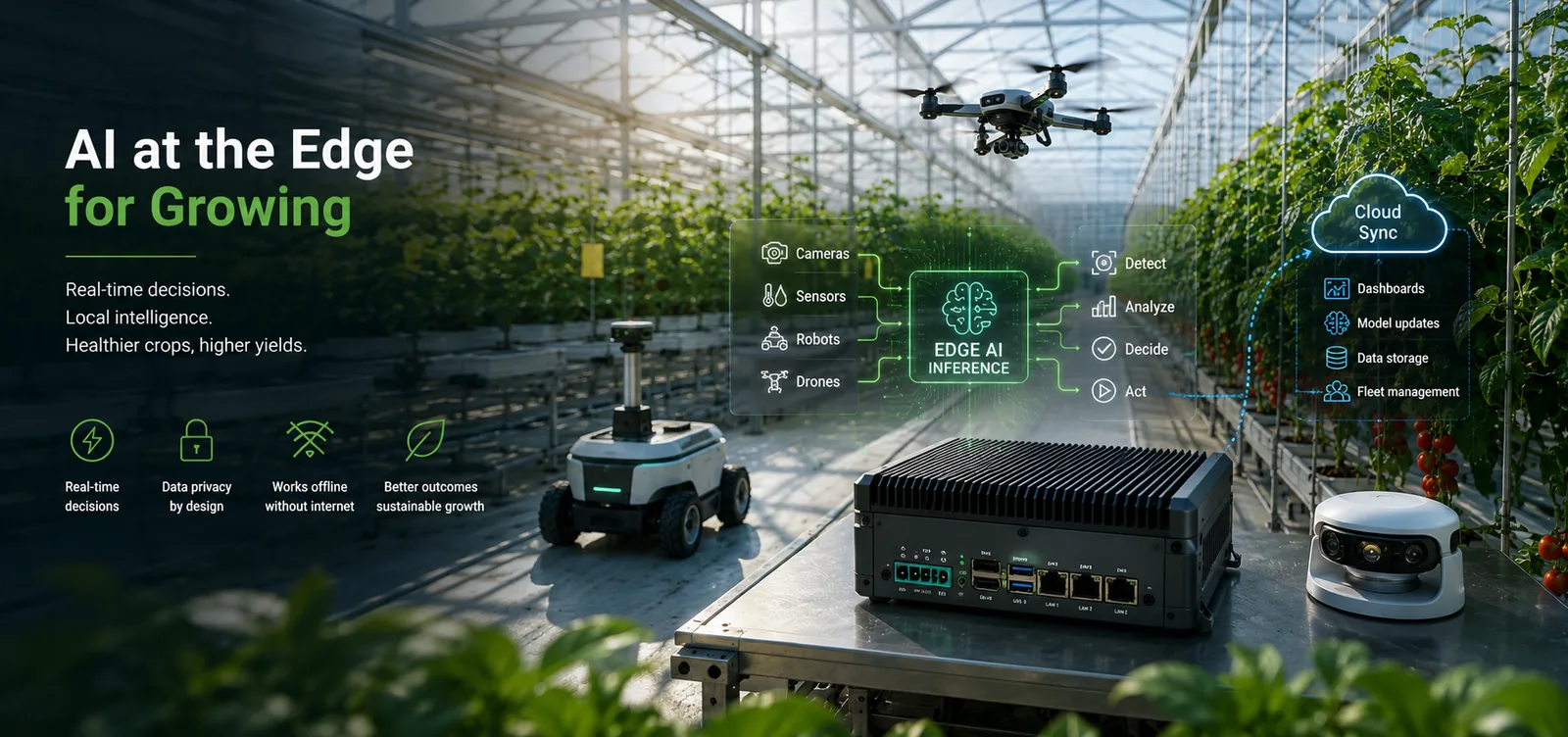
The central idea is simple, and it holds up under scrutiny: AI should run where the decision happens. Keeping inference local gives real-time decisions, offline operation, privacy by default, lower latency, and the autonomy that robots and drones need to work without a babysitter.
What Edge AI actually means
Three terms get mixed up often, so it helps to separate them.
Cloud AI runs the model in a data centre. A device captures an image or a reading, sends it over the internet, waits for a server to run the model, and receives the answer back. It is the easy way to start, because the hardware on the device stays cheap and the heavy compute lives somewhere else.
Edge AI runs the model on or next to the device that captured the data. The compute sits in the greenhouse: on a robot, on a camera, or on a small industrial computer at the end of a row. Nothing has to leave the building for a decision to be made.
On-device inference is the narrowest case of edge AI, where the model runs on the same board as the sensor. A smart camera that detects disease in its own processor and outputs a result, with no separate computer, is doing on-device inference.
A useful way to picture the difference: cloud AI is like posting a photo to an expert and waiting for a letter back. Edge AI is having the expert standing next to you. Both can give the same answer. Only one gives it in time to act.
[Figure: Cloud AI vs Edge AI. A split diagram. On the left, a camera sending a frame over the internet to a data centre and waiting for a reply. On the right, the same camera feeding a local edge computer that answers in place.]
Why latency matters
Latency is the time between capturing data and getting a usable answer. For a dashboard that a grower reads once an hour, latency does not matter. For a machine that has to act, it decides whether the system works at all.
A cloud round trip is not one number. It is a chain: compress and send the frame, cross the network, wait in a queue, run the model, and send the result back. Under good conditions that chain can be quick. The problem is that greenhouses do not offer good conditions. A thermal screen closes and the wireless signal drops. A steel gutter blocks a link. A shared connection saturates the moment every device reports at once.
Consider what that means in practice:
- An autonomous robot driving a concrete path has to see an obstacle and stop within its own braking distance. If the decision has to reach a server and come back, the robot is only as safe as the worst network moment during its shift.
- A drone inspecting a crop has to hold position and avoid structure continuously. A late answer is a collision.
- A greenhouse vehicle following a rail or a line cannot pause mid-move to ask a data centre whether to keep going.
- Quality inspection on a moving grading line has to keep pace with the belt. A delayed verdict means the produce has already passed.
- Disease detection during a scouting run has to flag a leaf while the camera is still in front of it, so the location is logged and a person can return to it.
In each case the decision and the action share a short window, measured against how fast the plant, the machine, or the belt moves. Local inference fits inside that window. A cloud round trip gambles that the network will cooperate at exactly the wrong second.
Cloud versus edge, side by side
Neither approach is universally better. They make different trade-offs.
| Dimension | Cloud AI | Edge AI |
|---|---|---|
| Latency | Tens to hundreds of milliseconds, and variable | Consistent and local, set by the device |
| Bandwidth | Sends raw data continuously; costly at scale | Sends only results and summaries |
| Reliability | Fails when the connection fails | Keeps working offline |
| Privacy | Raw images and data leave the site | Sensitive data can stay on site |
| Operating cost | Ongoing compute and data-transfer fees | Mostly upfront hardware cost |
| Scalability | Add cloud capacity, but bandwidth grows with every camera | Add a device per zone; each is independent |
| Maintenance | Central, one place to update | Distributed; needs fleet tooling |
| Energy use | Data-centre compute plus constant transmission | Efficient local chips, no constant uplink |
The honest reading of this table is that edge wins where decisions are time-sensitive, connectivity is unreliable, or data is sensitive, and cloud wins where you need to pool data, train models, or run analytics that no single device could hold. Most real systems use both, which the later architecture section covers.
Why greenhouses gain more than most industries
Edge AI helps many industries. Greenhouses sit near the top of the list, for reasons that stack on top of each other.
Connectivity is genuinely hard. Glass, steel, water, condensation, and dense planting all scatter and absorb wireless signals. Coverage that looks fine on an empty site degrades once the crop grows in.
Facilities are large and repetitive. A site can run to many hectares under one roof, with long rows and many identical zones. Wiring every corner for reliable high-bandwidth backhaul is expensive, and covering it with one central AI service means moving enormous amounts of video.
Sensing is continuous and camera-heavy. Climate sensors, cameras on robots, fixed inspection cameras, and drones all produce data around the clock. Sending all of it to the cloud is the most bandwidth-hungry way to run the site.
Robotics and safety are in play. Once machines move among people and plants, decisions about stopping and steering cannot depend on a link. Safety functions in particular should never wait on a network.
Privacy and local rules matter. Cameras capture workers as well as crops. Processing footage on site, and sending out only anonymous results, is the cleanest way to respect both staff privacy and regional data-protection law.
Put together, a greenhouse is exactly the setting where local decisions, offline resilience, and on-site data handling pay off the most.
What you can actually run at the edge
Edge AI in a greenhouse is not one application. It is a set of them, each with its own sensors, model type, output, and business value. The following are the common ones.
Disease and pest detection
Cameras on robots or fixed points feed a vision model trained to spot the visual signatures of disease and pests. The output is a flagged location and a confidence level. The value is early intervention: catching an outbreak while it is small is the difference between treating a patch and losing a block.
Plant counting and growth-stage classification
The same camera streams feed models that count plants and classify each by growth stage. The output is a live census of the crop and where each part of it sits in its cycle. The value is planning: labour, inputs, and space allocated against what is actually growing, not an estimate.
Yield estimation and harvest prediction
Vision models that count and size fruit, combined with growth-stage data over time, estimate yield and predict when a zone will be ready. The output is a forecast per zone and per week. The value is smoother selling and staffing, because you know what is coming before it arrives.
Climate optimisation
Climate sensors (temperature, humidity, CO2, light, and more) feed models that recommend or drive setpoints. The output is a control action or a suggestion to the climate computer. The value is crops kept closer to their ideal conditions with less energy waste.
Robot and drone navigation
Cameras, depth sensors, and inertial sensors feed perception and localisation models that let a machine work out where it is and what is around it. The output is a safe path and obstacle avoidance, computed on board. The value is machines that keep working through a dropped link, which is the precondition for autonomy at all.
Defect detection and quality grading
On a grading or packing line, cameras feed a model that sorts produce by size, colour, and defects. The output is a grade and a divert signal to the line. The value is consistent quality and less manual sorting.
Worker safety
Cameras and proximity sensors feed models that detect people near moving machinery. The output is a slow-down or stop. The value is obvious, and it is the clearest case for keeping the decision local, because a safety stop must never wait for a server.
Inventory and asset tracking
Cameras and tags feed models that track trolleys, crates, and equipment across the site. The output is a live map of where things are. The value is less time lost searching and fewer stalled tasks.
Choosing edge hardware
The right hardware depends on how much vision work runs, how many cameras feed one device, and the power and heat budget where it will sit. These are the common options.
| Platform | Strengths | Trade-offs | Good for |
|---|---|---|---|
| NVIDIA Jetson | Strong GPU for vision, mature tooling | Higher cost and power draw | Robots, drones, multi-camera vision |
| Raspberry Pi 5 | Cheap, flexible, widely supported | Limited AI throughput on its own | Light sensing, prototypes, single low-rate camera |
| Intel NUC and industrial PCs | General-purpose CPU, x86 software | No strong AI accelerator by default | Aggregating sensors, running control logic |
| Luxonis OAK cameras | AI runs inside the camera | Fixed to the camera's capability | On-device detection with no separate computer |
| Google Coral TPU | Efficient accelerator for small models | Best with a narrow model set | Adding fast inference to a Pi or an industrial PC |
Two rules of thumb hold. First, match the compute to the model and the frame rate, not to a spec-sheet number. Second, treat power and heat as first-class constraints, because a greenhouse is warm and humid and a fanless, sealed device often outlasts a faster one that cannot shed heat.
Choosing the model
The model family matters as much as the hardware. A short guide to the common ones and when each fits.
- YOLO family: fast object detection. The default choice for real-time counting, disease spotting, and obstacle detection on modest hardware.
- RT-DETR: a transformer-based detector that trades some speed for accuracy. Worth it when detection quality matters more than the last few frames per second.
- Segment Anything (SAM) and segmentation models: outline the exact shape of a leaf, fruit, or defect rather than just boxing it. Useful for sizing and precise measurement, usually too heavy for the fastest loops.
- MobileNet and EfficientNet: compact classifiers built for small devices. A good fit for growth-stage classification and simple grading on a Pi-class board.
- Vision Transformers (ViT): high accuracy on hard visual tasks, at a higher compute cost. Reserved for cases where accuracy justifies bigger hardware.
- LLMs on the edge: small language models running locally can summarise events, answer questions about the site, or drive an on-site assistant, without sending operational data off site. Capable but demanding, and best on stronger edge hardware.
The engineering trade-off is always the same triangle: accuracy, speed, and the hardware you are willing to power and cool. Picking a model is choosing a point inside that triangle for a specific job.
A reference architecture
A working greenhouse system is a pipeline. Data flows from sensing to a decision to an action, with the cloud handling the slow work behind it.
Camera / Sensor
      |
   Edge AI            (inference: detect, classify, measure)
      |
 Decision Engine      (rules and thresholds turn a result into an action)
      |
 Robot / Greenhouse Controller
      |
 Cloud Synchronisation   (summaries, history, model updates)
The connections between these parts use a few standard protocols. MQTT is the common choice for lightweight messages between many devices, because it is efficient and tolerates flaky links. REST APIs handle request-and-response calls, such as fetching a configuration. OPC-UA is the industrial standard for talking to climate computers and control equipment, so a decision engine can act on the greenhouse itself. A local database on the edge device buffers results so nothing is lost when the connection drops, and cloud storage holds the long record once the link is back.
[Figure: Greenhouse edge architecture. A horizontal pipeline from cameras and sensors, through an edge AI computer and a decision engine, to a robot or greenhouse controller, with a dashed line up to the cloud for sync.]
Edge and cloud, together
Edge AI does not replace cloud computing. It changes what each does. The fast, closed loop stays local: sense, decide, act, in the moment. The cloud does the heavy, slow work that is fine to do later.
A healthy hybrid uses the cloud for:
- Model updates: training the next version on data gathered across the whole site, then pushing it out to every device.
- Dashboards: giving growers and managers one view of every zone.
- Analytics: comparing this week to last, this house to that one, this season to the last.
- Fleet management: knowing the health and version of every device, and updating them safely.
- Historical data: the long record that no single edge device could hold.
- Remote monitoring: checking a site from anywhere, without a truck roll.
The split is not a compromise. It is each layer doing what it is good at. The edge decides and stays alive when the link dies. The cloud remembers, learns, and shows the whole picture.
[Figure: Robot plus edge computer plus cloud. A robot in a row, a small edge computer on board, and a dashed uplink to a cloud panel showing dashboards and a model-update arrow coming back down.]
Security and compliance
Keeping processing local is good for security, but it is not automatic. A few practices make it sound.
- Local processing is the first line: if raw camera footage never leaves the site, most privacy risk never leaves either. Send out results and summaries, not video.
- GDPR and similar rules apply the moment a camera can capture a person. Processing on site and storing only anonymous outputs is the cleanest path to compliance, and it should be documented.
- Encrypted communication protects the data that does travel, both between devices on site and up to the cloud.
- Device authentication ensures every edge device has its own identity, so a rogue device cannot join the fleet or a real one cannot be impersonated.
- Secure updates matter because a fleet you can update remotely is a fleet an attacker would like to update too. Signed updates and verified boot keep that door shut.
The economics
The case for edge AI is financial as much as technical. The numbers below are illustrative, meant to show the shape of the return, not a promise of specific results.
Consider a mid-sized operation weighing an automated scouting and detection system.
- Labour. Suppose manual scouting takes two people a day each week. Automating the first pass and sending them straight to flagged locations can recover a large share of that time for higher-value work.
- Crop loss. If early detection catches an outbreak even a few days sooner and prevents the loss of a small percentage of a high-value crop, that single event can exceed the cost of the hardware.
- Harvest speed and accuracy. Better yield prediction lets you staff and sell against what is actually coming, reducing both overtime and waste.
- Cloud and bandwidth costs. A site streaming many camera feeds to the cloud pays for that data every month. Processing on the edge and sending only results turns a recurring bill into a one-time hardware purchase.
The pattern is consistent: edge AI moves cost from ongoing fees to upfront hardware, and it pays back fastest where labour is expensive, crops are valuable, and losses are sudden. The right way to size it is a simple model of your own labour hours, crop value, and current data costs, run against the cost of the devices.
Where this is going
The direction of travel is clear, even if the timeline varies by operation.
- Autonomous greenhouses, where sensing, decisions, and machines close the loop on routine tasks with light supervision.
- AI agents that plan and coordinate tasks across a site, not just run a single model.
- Edge LLMs that let staff ask a site questions in plain language and get answers grounded in local data.
- Digital twins, live models of a greenhouse used to simulate and tune before acting on the real thing.
- Collaborative robots that work safely alongside people rather than behind barriers.
- Swarms of drones that cover a large site together, each deciding locally while sharing a common picture.
Every one of these depends on decisions made locally and reliably. The edge is the foundation the rest is built on.
When to use edge, and when cloud is enough
The takeaways, kept practical.
Use Edge AI when a decision has to be fast, a machine has to keep working through a dropped link, safety is involved, data is sensitive, or bandwidth costs are climbing with every camera you add.
Cloud AI is enough when the task is analysis rather than action, the data is not sensitive, latency does not matter, and you want to pool information or train models across a whole operation.
Most real systems use both. Decide at the edge, learn in the cloud, and design the split deliberately rather than defaulting to one.
Next steps if you are considering it: start with one job where the payback is clear, such as disease detection or a safety stop. Measure your own labour, crop value, and data costs so the business case is yours, not a generic figure. Choose hardware and a model that match that one job, prove it on a defined zone, then extend across zones and tasks once it works.
Growmatics builds the machines and the intelligence for exactly this: systems that see, decide, and act where the growing happens, with the cloud behind them for learning and oversight. It sits alongside the work we describe in what we build. If you are weighing edge AI for a controlled environment, tell us what you grow and we will tell you honestly whether we are the right team for it.